

Product Center

达州DG-MWQ-III Multi-parameter Online Water Quality Monitor
Product Description
I. Application Scenarios
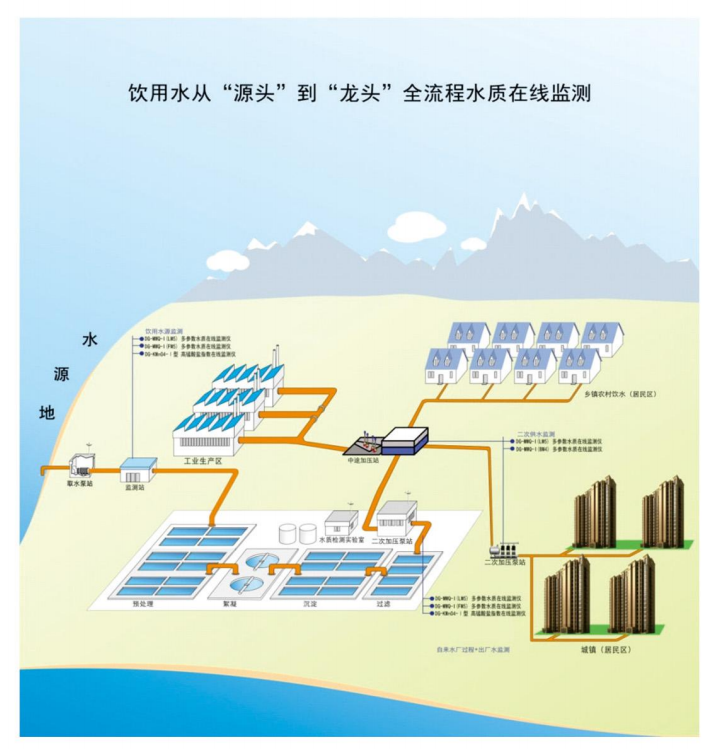
Tap water leaving the plant
Water supply network water
Secondary Water Supply
Surface water
Water Source Area
II. Product Features
High integration
High precision
Zero pollution
High Reliability
Cloud Monitoring
Digitalization
Alternative to imported products
III. Technical Specifications
● Measurement configurations: pH/Residual Chlorine/Conductivity/Turbidity/Temperature (Note: Actual parameters shall prevail based on the specific order details)
● Measurement range: pH: (0–14.00) pH; Temperature: (0–100)°C;
Residual Chlorine: (0-20) mg/L; Turbidity: (0-100) NTU
Electrical Conductivity: (0–2000) µS/cm
● Resolution and Interface: Resolution: 0.01 pH, Accuracy: ±1% FS
Resolution: 1 μs/cm, Accuracy: ±2% FS
Resolution: 0.01 mg/L, Accuracy: ±1% FS
Resolution: 0.01 NTU, Accuracy: ±1% FS
Resolution: 0.1℃, Accuracy: ±0.5%℃
● Communication interface: RS485
● Power supply: AC220V ±10%
● Operating environment: (0–50)℃
● Storage environment: Relative humidity: ≤85% RH (no condensation)
IV. Measurement Principle
PH: Hydrogen ions selectively permeate through the outer membrane of the working electrode, generating an electrochemical potential. This potential depends on the pH of the medium. The electrode incorporates Ag/AgCl as a reference electrode, ensuring a stable potential that remains unaffected by changes in the medium's acidity or alkalinity. The transmitter uses the Nernst equation to convert the potential difference between the working and reference electrodes into the corresponding pH value. Conductivity: Two coaxially arranged electrodes are placed in the sample solution. A voltage is applied across the electrodes, and the resulting current is measured. Using Ohm's law, the conductivity (G) or resistance (R) is calculated. Finally, the conductivity is determined by multiplying the measured G or R value by a structure-specific electrode constant (K). Turbidity: Suspended particles scatter incident light in various directions. Among these, 90° scattered light is less influenced by particle size and is therefore commonly used for turbidity measurement. A light source emits illumination, and the intensity of scattered light at the 90° angle is detected. The transmitter then calculates the turbidity level based on the detected scattered light intensity. Residual Chlorine: The residual chlorine electrode operates under a constant voltage, forming a micro-battery system consisting of two platinum electrodes and a reference electrode. During measurement, a stable potential is maintained at the electrode's sensing end. Different components being measured generate distinct, linearly proportional current intensities at this specific potential. The transmitter converts the measured current value into a residual chlorine concentration reading.
V. Solutions
Online Monitoring Solution for Comprehensive Water Quality Safety in the Drinking Water Supply Chain

Jiangsu Degao Internet of Things Technology Co., Ltd.
Consulting
+86 15996603530
degao@163.com
Address
No. 158, Xinsheng Road, Nantong, Jiangsu, Maipu Technology Park
Subscription Number
Service Number
Mobile phone QR code
Copyright © 2025 Jiangsu Degao Internet of Things Technology Co., Ltd.
Website Construction:Zhongqi PowerNantong|Tag|City Substation